
August 5, 2026
Q2 2026 Real Estate Market Update
Now that Q2 2026 has come to a close, I wanted to share a brief overview of the Cayman Islands real estate market so far this year, covering key trends in sales volume, transaction activity, inventory levels, and pricing, along with my perspective on where the market may be headed over the remainder of 2026.
Please note that all figures included in this article are taken from CIREBA and are quoted in US dollars.
A look at sold transactions and volume
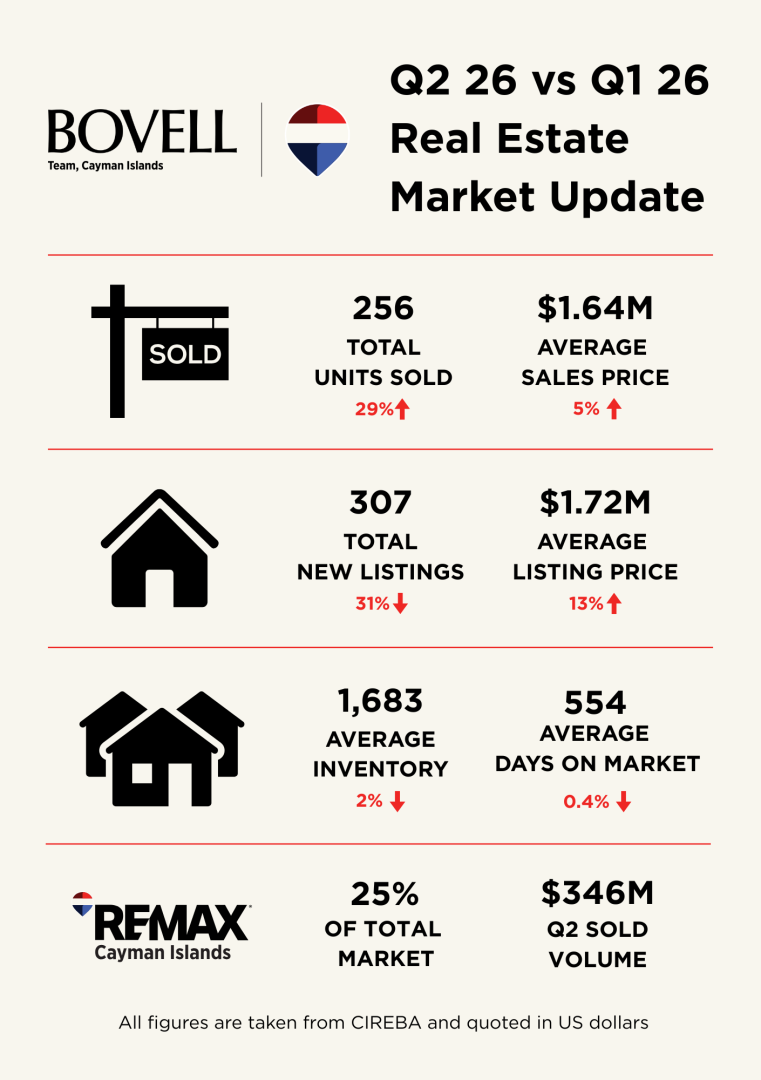
In Q2 2026, the total number of sold transactions were 256 up by 29.3% over Q1 2026.
With respect to volume, Q2 2026 saw $412.9M in sales, up 32.7% over Q1 2026.
As I’ve mentioned in previous articles, the Cayman Islands is a relatively small real estate market and thus can be greatly influenced by slight shifts in the market, it is important to note that two key factors greatly contributed to this quarter’s statistics.
In Q2 2026, 11 units went from pending to sold for The Watermark which totalled US $124.2M in sold revenue. Additionally, 49 units sold in Q2 2026 at ONE|GT totally US $37M. The total sold volume in Q2 2026 was $419.9M of which The Watermark represented over 30% of those sales. Combined, ONE|GT and The Watermark represented over 39% of all sold volume in 2026.
Given the impact of The Watermark and ONE|GT, it’s not surprising that the first half of 2026 saw more than $725M in sold volume, which is a record for the first half of the year.
New listings
When you look at new listings, we saw a total of 307 new listings in Q2 2026. This number declined by 31% over Q1 2026.
With respect to the value of these new listings, Q2 2026 saw $536.2M, which is down by 21% compared Q1 2026.
As with the sold data, it’s important to consider the factors driving changes in the market. At the end of March, more than 40 land listings entered the market, with an average list price of approximately CI$150,000. While a surge in new listings naturally increases overall inventory, a large number of lower-priced properties will reduce the average listing value. In other words, more listings don’t necessarily translate into higher overall market value if they are concentrated at lower price points.
Therefore, it is not surprising to see a 31% decline in the listings quarter-over-quarter. It’s important to note that the decline in the value at 21% also means that higher priced properties came to the market in the 2nd quarter versus the first quarter, and prices, overall continue to increase.
Average price per listing – solds and new listings
In Q2 2026, the average price per sold listing was $1.644M compared to $1.571M in Q1 2026, a 4.7% increase.
The average price per new listing in Q2 2026 was $1.729M up from $1.532M in Q1 2026, a 12.8% increase.
Inventory is down
Not surprisingly, inventory is down. 60 active listings were sold just between The Watermark and ONE|GT in Q2 2026; 23.4% of all sold listings. Although inventory levels fluctuate monthly, the average monthly inventory for Q2 2026 is down to 1,683. This is down from an average of 1,721 in Q1 2026, which is a decrease of 2.2%.
The 2nd half of 2026 and the Cayman Islands real estate market
New development pre-sales
One of the most important factors influencing the Cayman Islands real estate statistics in 2026 continues to be the completion of major pre-construction developments.
As discussed in my previous market updates, several large-scale projects that began selling years ago are now reaching completion, allowing hundreds of pre-sale contracts to transition into completed sales. Developments such as Grand Hyatt, Serrana and Dolphin Point Club are among those expected to make a significant contribution to this year’s transaction figures.
As of the time of writing, there are 240 pending properties with a combined value of approximately $638.7 million, along with 204 pending/conditional properties valued at approximately $185.5 million.
The significance of these figures cannot be overstated. There are currently 1,584 active listings across the Cayman Islands, but 444 of those listings are already pending or pending/conditional. In reality, that leaves just 1,140 properties genuinely available for purchase, highlighting how limited the active inventory has become.
The combined value of pending and pending/conditional sales now stands at approximately $824.2 million. While these transactions have not yet officially closed, they are effectively sold. Some have remained in pending status for more than five years, particularly large-scale development projects such as the Grand Hyatt. As these transactions eventually close, they will have a significant impact on future market statistics.
Has this type of situation influenced Cayman Islands real estate statistics before? Absolutely. However, the scale is unprecedented. The rapid growth in new development projects over the past five-plus years has created a much larger pipeline of high-value transactions waiting to close. In fact, among the 100 highest-priced pending sales, only 15 properties are not part of new developments, underscoring how profoundly the development sector is shaping today’s market—and the statistics that will emerge in the years ahead.
This pattern is expected to extend well beyond 2026. A number of other landmark developments—including Hyatt Centric, Aqua Bay, Lacovia, Catalina Bay, Mandarin Oriental and RIA—are scheduled to complete in 2027 and subsequent years, resulting in additional waves of pre-sale contracts being recorded as closed transactions.
Understanding this distinction is essential when analysing Cayman Islands market data. The completion of a single large development can have a meaningful impact on annual sales volume and transaction totals.
Grand Hyatt illustrates this perfectly. Although many of the residences are projected to close this year, the majority of those purchase agreements were secured several years ago, with some dating back as far as five years. More than 160 residences were sold before construction was completed, and with the development now fully sold out and continuing with a strong resale market, those long-standing contracts are simply being reflected in today’s sales statistics.
As a result, this skews our annual transaction figures in addition to the annual sold values, reflecting yesterday’s sales in today’s market which does not give a true reflection of the ongoing consistent activity that Cayman’s real estate market has experienced over the last few years.
Stamp Duty Revenue of CIREBA Sales Activity
Stamp duty, which is payable upon the completion of every property transaction, is one of the Cayman Islands Government’s most significant sources of revenue. Effective January 1, 2026, the stamp duty rate increased to 10% for properties valued at CI$2 million and above, while transactions below that threshold continue to be taxed at 7.5%.
Based on approximately US$725 million in real estate sales during the first half of 2026, the government would have collected more than US$54.4 million in stamp duty even if every transaction were taxed at just 7.5%. Given that many high-value transactions are now subject to the 10% rate, actual stamp duty collections are significantly higher.
Interest rates
The direction of U.S. interest rates will remain a factor influencing the Cayman Islands property market, as it always does, during the second half of 2026. At its June meeting, the U.S. Federal Reserve held the federal funds rate steady at a target range of 3.50% to 3.75%, citing continued economic growth alongside inflation that remains above its long-term 2% target.
While inflation has moderated significantly from its peak, the Federal Reserve continues to adopt a cautious, data-driven approach before making any further policy adjustments. Financial markets generally expect borrowing costs to ease over time if inflation continues to cool, although the timing and pace of any future rate reductions remain uncertain.
Booming tourism
Earlier this year, I highlighted the Cayman Islands’ exceptional start to 2026, noting that January had delivered the strongest month for stayover air arrivals in the country’s history. The momentum has not only continued but accelerated, placing the destination firmly on course for a record year for tourism.
Visitor numbers remained exceptionally strong throughout the first quarter. February welcomed 49,075 stayover visitors, making it the second-highest February ever recorded and representing a 10.1% increase over the same month in 2025. March then set a new record, with 64,213 visitors arriving by air—the highest monthly total the Cayman Islands has ever achieved.
Expanded air service has played a significant role in supporting this growth. During March, inbound airline seat capacity from the United States, Canada and the United Kingdom increased by 5.9% compared with the previous year. Additional flights from major hubs such as Chicago, Miami and New York, together with increased capacity from Toronto and the introduction of a new Ottawa route, have further strengthened access to the Cayman Islands.
The United States continues to be the islands’ largest tourism market, while Canada has emerged as one of the fastest-growing sources of visitors, recording a 49% increase in arrivals compared with March 2025 driven in part by a sustained shift in Canadian travel patterns away from the United States due to ongoing political and trade tensions.
The UK and Ireland also delivered impressive results, with visitor numbers climbing 32.2% year over year to achieve their second-highest March total on record.
Based on the strength of current trends, there is every reason to expect visitor numbers will continue to grow throughout the remainder of the year. The 382-room Grand Hyatt will increase the Cayman Islands’ hotel inventory by approximately 4.5% on its own. Combined with the opening of ONE|GT (97 rooms), these projects represent a significant expansion in tourism capacity and are expected to support continued growth in visitor arrivals, employment, and demand for real estate. A rough calculation of this new inventory should generate an estimated additional US $8 million in tourism tax for the Cayman Islands government, which will be reoccurring revenue. Please note this doesn’t include the knock-on effect of all these additional visitors on island from dining out to tourist attract.
As of writing this article, the current hotel occupancy rates at least three major hotels on island are ranging from 80% through 90%, which is quite impressive given that we are heading into August typical a shoulder season.
In closing
Looking ahead, the Cayman Islands property market appears well positioned for the remainder of 2026. While global economic uncertainty and geopolitical developments may influence buyer sentiment in the short term, the jurisdiction’s strong economic fundamentals, record tourism, and enduring appeal to international investors continue to provide a solid foundation for long-term stability. Although population growth has moderated from the exceptional pace experienced in recent years, demand for housing continues to outpace available supply.
Affordability remains one of the market’s most significant challenges. At its core, housing affordability is driven by the balance between supply and demand. There are only two sustainable ways to improve affordability: moderate population growth or increase the supply of available housing. While population growth has slowed, inventory remains constrained, and the rising cost of land, labour, materials, and construction continues to place upward pressure on new home prices. As additional residential developments are completed and more inventory becomes available, buyers should benefit from greater choice and improved affordability.
Encouragingly, affordable housing opportunities do exist. RIA, Executive Suites, and the release of 40 residential parcels of land are positive steps toward expanding homeownership opportunities. Continued investment in housing across a range of price points will be critical to ensuring that the Cayman Islands remains an attractive place to live, work, and invest while supporting the long-term health and sustainability of its real estate market.