
October 28, 2026
Q3 2026 Real Estate Market Update
With Q3 2026 now behind us, I wanted to take this opportunity to share an overview of the Cayman Islands real estate market’s performance year to date. This update highlights key trends in sales volume, transaction activity, and property pricing, along with my insights into the factors shaping the market and what we can expect as we move through the final quarter of 2026.
Please note that all figures included in this article are taken from CIREBA and are quoted in US dollars unless otherwise noted.
A look at sold transactions and volume
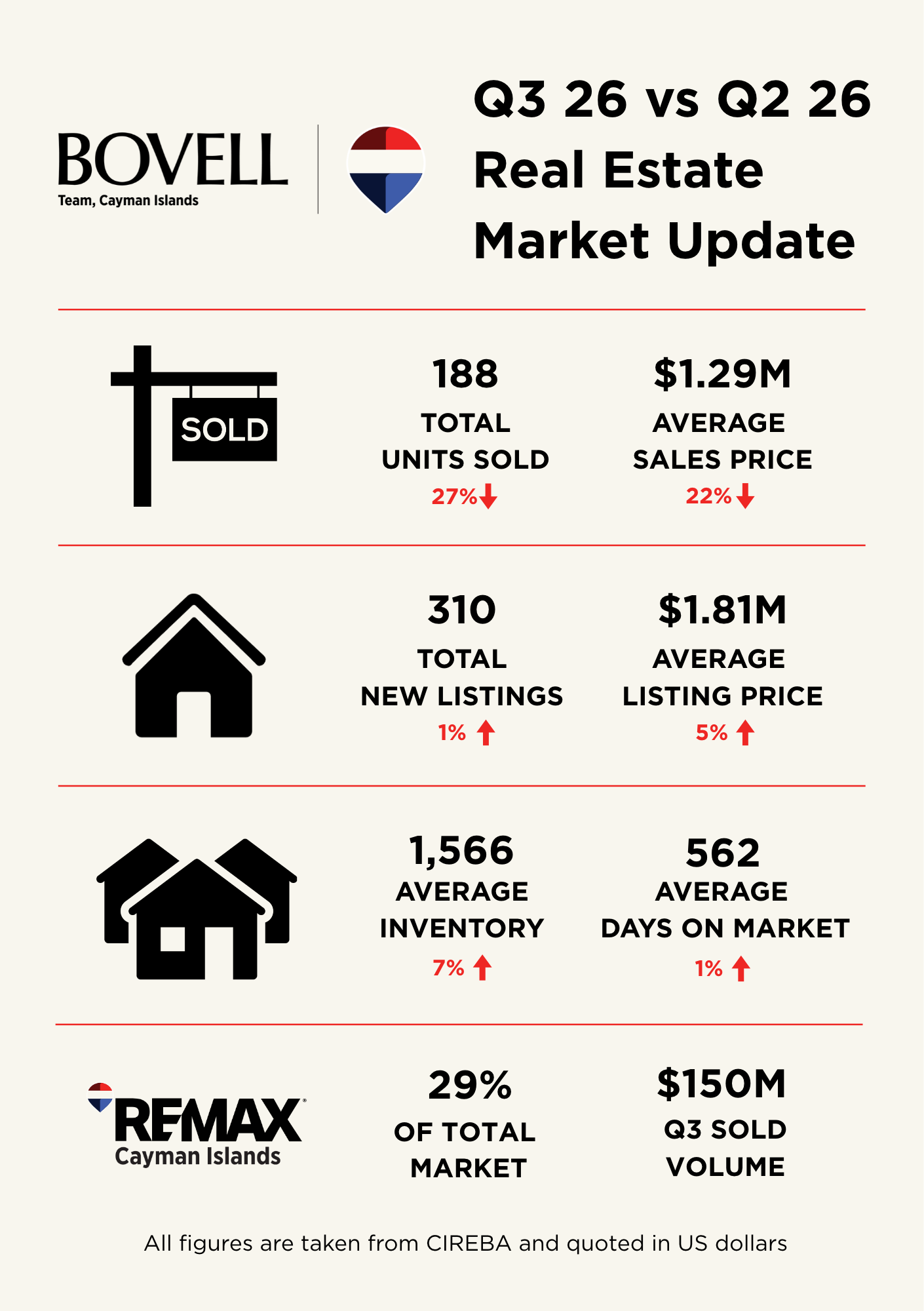
In Q3 2026, the total number of sold transactions were 188 down by 26.5% over Q2 2026.
With respect to volume, Q3 2026 saw $244M in sales, down by 40.8% over Q2 2026.
This certainly doesn’t mean the sky is falling! In fact, a closer look at the Q3 2026 figures reveals some important context. During the quarter, 11 units at The Watermark transitioned from pending to sold, accounting for an impressive US$124.2 million in sales volume. Additionally, ONE|GT recorded 49 unit sales totalling US$37 million, representing nearly 9% of the quarter’s total market activity. With overall sales volume reaching US$419.9 million in Q3, The Watermark alone accounted for nearly 30% of all sales. Combined, The Watermark and ONE|GT represented more than 38% of the quarter’s total sales volume, highlighting the significant impact these two developments had on the overall market figures.
New listings
When you look at new listings, we saw a total of 310 new listings in Q3 2026. This number is marginally up by 1% compared to Q2 2026.
With respect to the value of these new listings, Q3 2026 saw $562.6M, which is up by 4.9% compared Q2 2026.
Average price per listing – solds and new listings
In Q3 2026, the average price per sold listing was $1.290M compared to $1.644M in Q2 2026, a 21.5% decrease. This is not surprising given that the 11 units at The Watermark that closed in Q2 had an average price of $11M.
The average price per new listing in Q3 2026 was $1.812M up from $1.729M in Q2 2026, a 4.8% increase.
The Cayman Islands real estate market – Q4 2026 and into 2027
Interest rates
U.S. interest rates remain an important factor influencing the Cayman Islands real estate market as we enter the final quarter of 2026. At its September meeting, the Federal Reserve increased its benchmark interest rate by 0.25 percentage points to a target range of 3.75%–4.00%, reflecting continued economic strength and persistent inflation above its 2% target.
With further rate increases possible before year-end, borrowing costs are likely to remain elevated in the near term. While this may influence some buyers’ purchasing decisions, the Cayman Islands continues to attract international investors, particularly in the luxury and cash-buyer segments, where sensitivity to interest rates is generally lower.
New development pre-sales
One of the most significant factors influencing Cayman Islands real estate statistics in 2026 continues to be the completion of major pre-construction developments. As highlighted in my previous market update, projects such as Grand Hyatt, Serrana and Dolphin Point Club are now reaching completion, with pre-sale contracts secured several years ago finally transitioning into recorded sales.
While this is not a new phenomenon, the scale is unprecedented and will continue to shape market figures well beyond 2026, with developments such as Hyatt Centric, Aqua Bay, Lacovia, Catalina Bay, and Mandarin Oriental expected to contribute in the coming years.
The key takeaway is that today’s recorded sales often reflect purchase decisions made several years ago, rather than current market activity. Grand Hyatt is a perfect example, with more than 160 residences pre-sold before completion, some as far back as five years ago. As these transactions close, they can significantly inflate annual sales volumes and transaction totals, potentially distorting the true picture of current market conditions. For a more detailed explanation of this trend and its impact on Cayman Islands real estate statistics, I encourage you to revisit my previous market update.
Booming tourism
The Cayman Islands tourism industry continues to thrive in 2026, reinforcing the strength and international appeal of our islands. Through August, stayover arrivals reached 361,192 visitors, an impressive 11% increase over 2025, while total visitation, including cruise passengers, exceeded 1.13 million. With ten consecutive months of year-over-year stayover growth, increased airlift from key North American and European markets, and continued investment in luxury accommodations, the outlook remains extremely positive. As we approach the traditionally busy winter season, I anticipate even stronger visitor numbers in Q4 2026 compared to previous years, carrying into Q1 2027. This continued momentum should also provide a positive backdrop for the real estate market, supporting demand for vacation properties, investment opportunities and luxury residences.
Other factors – the good, the bad, and the ugly
Beyond interest rates and tourism, several other factors continue to shape the Cayman Islands real estate market, including limited land availability, rising construction and insurance costs, population growth and ongoing infrastructure investment. Global economic uncertainty, geopolitical developments and changes in international tax policies can also influence investor confidence and purchasing decisions. However, Cayman’s tax-neutral environment, political stability, strong financial services sector and desirable lifestyle continue to attract international buyers. As we move into 2027, the balance between new development, available inventory and buyer demand will remain particularly important in determining the direction of property prices and overall market activity.
In closing
As we head into the final quarter of 2026, the Cayman Islands real estate market continues to demonstrate resilience, supported by strong tourism, ongoing development activity and sustained international interest. While headline statistics don’t always tell the full story, the underlying fundamentals remain encouraging. Looking ahead to 2027, I remain optimistic about the opportunities our market has to offer and, as always, encourage buyers, sellers and investors to look beyond the numbers to better understand the trends shaping our unique real estate landscape.